


Delving Into the Details
News & Insights
Reading a Gear Print: The Callouts We Actually Need to Quote Your Fixture Fast
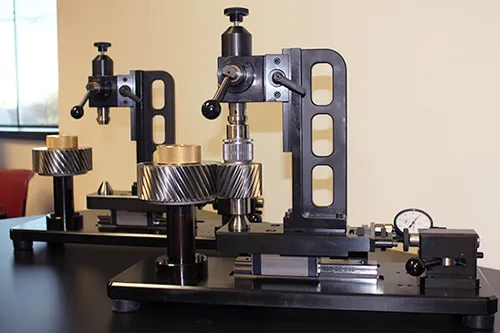
“Send us your print” appears on most pages of this site, and we mean it. But that invitation comes with an assumption we should probably stop making: that the print in your hand contains everything we need to quote a fixture.
Usually, it doesn’t. That does not mean anything is wrong with the drawing. A gear print is drawn so someone can manufacture the gear. A roll test fixture is a different tool with a different job, and some of the information that determines how we build it may live outside the production print.
So the quote clock doesn’t start when your email lands. It starts when we have the last callout needed to define the fixture. Everything between those two moments is us asking for a number, you forwarding the question to whoever owns the drawing, and a week disappearing from a schedule that probably did not have several days to spare.
Here is what we look for first, and what each one decides.
The five that do the most work
- Complete tooth data. Number of teeth, normal diametral pitch or module, normal pressure angle, helix angle and hand, and the profile standard the gear is cut to. This block decides the master gear. Everything else in the fixture is built around it. A print that gives us pitch diameter and a tooth count but leaves off pressure angle sends us back to you before we can finish the quote. Two gears with identical tooth counts but different pressure angles require different masters.
- Lead and profile tolerance, with the quality class. AGMA class or DIN/ISO grade, plus the specific lead and profile tolerance bands if your customer has tightened them past the class. This is the one that separates a fixture we can build in our standard configuration from one that needs tighter slide and bearing work. It also tells us whether the readings you plan to take are inside what a double-flank check can honestly resolve, which is a conversation better had at quote stage than after delivery.
- Center distance, nominal and operating. Theoretical center distance tells us the geometry. Operating or test center distance, when specified, tells us where the slide actually needs to sit and how much travel the fixture requires. If only one value appears on the print, tell us which one it represents. We have seen applications where the difference between theoretical and operating center distance was the central design question.
- Total composite and tooth-to-tooth tolerance. TCV and TTCV are the numbers the fixture reports against. If your customer’s print calls them out, include them. If the print is silent and the acceptance criteria come from an international specification or supplemental customer quality document, send that instead and let us know when it comes from outside the drawing. We would rather build to the real acceptance criteria than to the only one that happened to be printed.
- Material and heat treat condition at inspection. Carburized and hardened, through hardened, green, nitride, and the hardness range. Where in your process the gear gets checked changes the fixture. A green gear being checked before heat treat and a finish-ground gear being checked after are two different parts as far as wear, loading and master selection are concerned.
Contact ratio sits just behind these five. If your print calls it out, include it. If it doesn’t, complete tooth data gets us there.
What one missing number actually costs
The honest answer is rarely one day. The real cost is the round trip.
We read the print, find the gap, and write back. That email reaches you between two other things. You check whether the number is on a revision you have or on one the customer holds. If it’s the customer’s, you ask them, and now you are waiting on somebody who has no idea your fixture quote is stalled behind their reply. Four or five business days go by on a question that took us ninety seconds to identify.
We cannot responsibly quote around a guess. If we assume a pressure angle and it is wrong, the master is wrong. A wrong master is not a minor revision. It can mean rebuilding a critical part of the system.
So we ask, we wait, and the lead time you were planning around starts later than expected. Once the data is complete, the quote itself moves quickly. The waiting is the part worth eliminating.
Four things that are not on any print and change the quote anyway
How the gear locates. Bore and face, shaft centers, a splined hub, a shaft gear with its own journals. The mounting is a fixture decision, not a gear decision, so the drawing almost never settles it. Tell us how the part sits and we skip a phone call.
Who runs it, and how often. Manual, motorized, or pneumatic isn’t a budget tier. It’s a question of whether an operator is checking six parts a shift or sixty, and whether the same person runs it every time. Volume and operator changeover tell us which configuration is right faster than any spec does.
Whether this is one gear or a family. If three part numbers share a base geometry and differ in face width or tooth count, say so up front. Designing for the family from the start is usually cheaper than three separate fixtures, and it’s a decision we can only make before we start cutting.
What you already have on the floor. An existing master, a fixture from a previous program, or a base you would like us to evaluate. Sometimes the right answer is a new master against hardware you already own, and that quote looks very different from a new build.
Send it incomplete anyway
You don’t need to have every detail before reaching out. If you have the print and nothing else, send the print. We would rather start reading today and ask you two questions than have you hold the file for a week while you chase a number nobody has.
PDF is fine. A STEP or DXF of the gear helps. A marked-up screenshot with the tooth data block circled is fine too. Redact whatever your customer requires; the geometry is what we need, not their name.
Veit Tool typically returns quotes within 24 to 48 hours once the required information is available. Fixtures average about six and a half weeks out the door from Davison, CMM inspected before they ship.
The five callouts above help turn the first quote from provisional into something we can confidently design and build around. Bring them if you have them. If you do not, send the print anyway.
Stay Connected with Veit Tool!
Get company news and expert industry insights — spam-free and straight to your inbox. Sign up today!
Contact Us

(810) 658-4949

Send an Email

Headquarters
303 S. Dayton St.
Davison, MI 48423

Business Hours
Mon-Fri, 7:00am - 3:30pm

We're Hiring!
View Job Openings >


